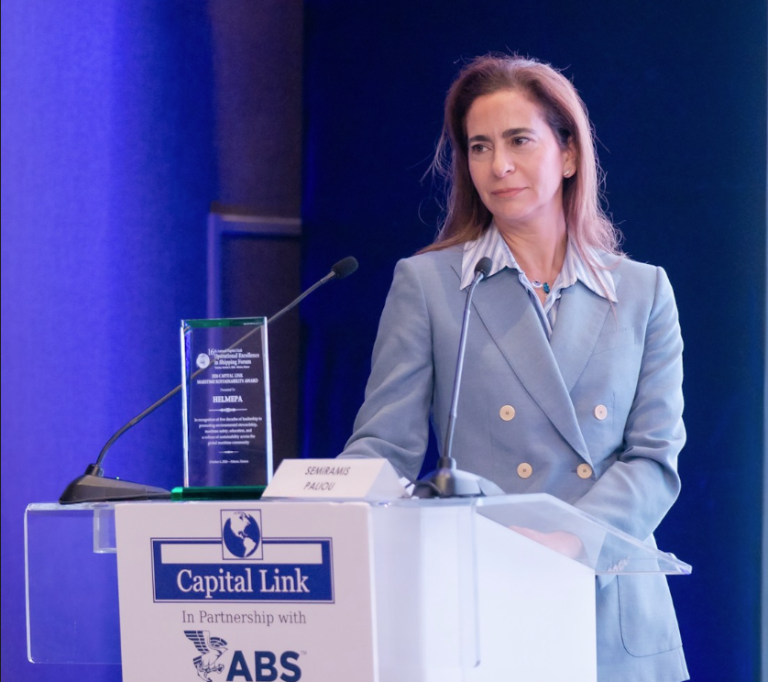
Capital Link recently hosted the 18th Annual Capital Link Shipping & Marine Services Forum on Tuesday, September 15, 2026, at 116 Pall Mall, in London.
This Forum offered investors a comprehensive review and up-to-date outlook on the various shipping markets, while also covering key topics of critical interest to industry participants, financiers, and stakeholders.
It brought together a high caliber audience of shipping professionals, financiers & investors, the forum offers insights into the current state of the shipping and marine services industries, regulatory updates, the implications for investments, and a focused look at the opportunities and challenges ahead.
The cash pile
The common denominator in this year’s conversations was the industry’s current wealth. Dr. Martin Stopford put the scale of the boom in numbers. The super-cycle running from 2021 to 2026 has generated some $3.1 trillion in cash, surpassing the $2.2 trillion accumulated between 2004 and the financial crisis.
Around 26% of that has gone to the shipyards so far, compared to more than a third in the earlier cycle. Ordering in 2007 reached 274 million dwt, and the run rate this year points to 275 million dwt for 2026.
Dr. Stopford’s biggest concern is timing. In 2023 he placed the next investment wave in the 2030s, by which point green technology would have matured and the digital picture settled. The injection of cash has pulled that ordering phase forward by eight years, which leaves the industry committing to vessels when the fuel question remains open and no economic measure has emerged from the IMO.
“So that means you’re going to get a bunch of ships today, and the question that leaves me asking is whether the ships we’re building with this bundle of cash are the right ships.
I’ve no doubt they’re full of dual-fuel engines and digital systems, but this is very early days for this sort of sophisticated technology, and where are the cargoes in all of this?”
He went back to the 1960s, when cargo interests helped design the ships they used. From the 1970s the earnings cycle took over, and capital went into vessels slightly larger than the ones they replaced. The orderbook now looks much as it did in 2008, which raises the question of another 2010 coming along.

Oil majors want 15 years
The tanker panel described charterers behaving in a way nobody had seen before. Mr. Harrys Kosmatos, chief financial officer of TEN Ltd, noted that oil majors are now pushing for 15-year contracts on specialist newbuildings, including shuttle tankers serving Petrobras platforms in Brazil. Ordinary time charters have stretched too.
“Up until the recent past it was one to three years on time charter or time charter renewals. Today, you can easily get five years, five to seven years. This is a recent development. We haven’t seen it to this extent.”
The buyers are Equinor, ExxonMobil and their peers, and what they want is a counterparty that will still exist when the charter ends.
According to Mr. Carlos Balestra di Mottola, chief executive of d’Amico International Shipping, his company is fielding requests for five to seven-year cover on ships that will not deliver until 2029 or 2030. Partly that reflects the market yes, but it also shows a fleet that is ageing faster than it is being replaced.
In turn, Mr. Mads Peter Zacho, chief executive of Navigator Gas, did point out that charterers are being asked to pay well above what they are used to. Similarly, Mr. Kosmatos commented that investors have come round to the same conclusion. TEN spent years being frowned upon for splitting the fleet between term and spot. That split now looks less like timidity and more like a floor under the business.

Two governments, one rulebook
The session that put governments on the stage produced the most concrete regulatory commitment of the day. According to Minister Keir Mather, the UK’s maritime minister, Britain has “committed to reviewing the UK ETS should a global measure be adopted at the IMO to avoid double payments being paid.” Owners have to be able to comply with a system and then thrive inside it, and an agreement only gets over the line if everyone works at it together.
Minister Marina Hadjimanolis, Cyprus’s shipping deputy minister, wanted “the same destination reached more carefully. “We want “a global measure, but a pragmatic and realistic one,” one that leaves owners stable enough to invest. Regional measures have hurt the sector before, and Cyprus has been on the IMO council since 1987 arguing the point.
The restocking wave behind this one
Mr. Pankaj Khanna, chief executive of Heidmar Maritime Holdings, remained concerned about the longer term changes to the industry. OECD stocks sit at 30-year lows. China has run its reserves down to avoid buying at the top. Refilling all of it, he said, will take 12 to 18 months from whenever the shooting stops.
Further than that the barrels now come from different places. Countries that discovered how exposed they were to a single chokepoint will buy more from the United States, Brazil and Guyana, which translated to longer voyages. Mr. Khanna also expects the peace to be hard on the shadow fleet. Hundreds of ageing tankers have avoided the beach for five years by carrying sanctioned oil, and a wave of demolition would take some of the sting out of the newbuildings now leaving Chinese yards.
Mr. Kosmatos made the same point from the cargo side. The barrels have to be replaced, and tankers are how that gets done.
Dr. Nikolas Tsakos, founder & CEO of TEN Ltd. (NYSE: TEN) commented on that front: “We prefer a peaceful world, a world with open seas. Right now, it’s literally like a minefield trying to navigate every day. We ended up having more admirals in the office than the captains.” He believes that the market is strong because energy is scarce,and he would take a sustainable business over a situation that puts crews at risk.

Did dry bulk get lucky?
Discussing the world of dry bulk, Mr. Khalid Hashim managing director at Precious Shipping, was unwilling to take credit for his sector’s discipline. Bulker owners have not been proactive in holding back from the yards, the executive credited. Tankers and boxships took the slots. Dry bulk simply could not order, and the supply side is healthier for it. Mr. Karim Coumine, head of commercial shipping of Anglo American, was happy with the result, pointing to market inefficiencies that are apparent and driving rates.
Demand held up better than anyone forecast in January. Chinese steel output is down 3% year on year, yet Precious Shipping is carrying about as much steel as last year, and iron ore imports keep climbing. Mr. William Fairclough, managing director of Wah Kwong, put that down to mills running on imported high-grade ore to limit losses.
Concerning Guinea, Simandou has barely started, and Mr. Vincent Vandewalle, CTO of Navios Maritime Partners expected the cargo to reach the market before the ships do, tightening capesizes further. Bauxite is already there with 45m tonnes shipped in 2023, 175m in 2025.
Panamaxes have had a thinner time of it, though coal and grain have kept them working, and some charterers are now splitting capesize cargoes down into them. Mr. Coumine’s warning was that the orderbook is filling up again.

The financing panels came back to Mr. Stopford’s question about an impdending crisis. Mr. Andrian Dacy, CEO & CIO at J.P. Morgan Asset Management, has come across small owners “that have $600m of excess cash on their balance sheets with the entire fleet paid off.” Buying anything today means paying up for assets that are printing money, which is precisely why they cost what they cost. His advice was to pay down debt. And after that, he’d advice investing in other areas.
Mr. Martin Huegger, managing director at Meerbaum Capital Solutions concluded that there are opportunities for anyone with the stomach for tanker risk.

Capital Link – Disclaimer
Capital Link’s webinars, podcasts, articles and presentations may contain “forward-looking statements.” Statements that are predictive in nature, that depend upon or refer to future events or conditions, or that include words such as “expects,” “anticipates,” “intends,” “plans,” “believes,” “estimates,” “projects,” “forecasts,” “may,” “will,” “should” and similar expressions are forward-looking statements. These statements are not historical facts but instead represent only the beliefs of each participating Company regarding future results, many of which, in their nature, are inherently uncertain and outside of the control of the Companies. Actual results may differ, possibly materially, from those anticipated in these forward-looking statements. For more information about risks and uncertainties associated with the participating companies, please refer to the regulatory filings of each participating Company with the SEC or other Stock Exchanges where they are listed.
Founded in 1995, Capital Link provides Investor & Public Relations and Media services to several listed and private companies, including companies featured in these webinars, podcasts, articles and presentations. All these, including the one mentioned above, are for informational and educational purposes and should not be relied upon. They do not constitute an offer to buy or sell securities or investment advice or advice of any kind. The views expressed are not those of Capital Link, which bears no responsibility for them. In addition, Capital Link organizes a series of industry and investment conferences annually in key industry centers in the United States, Europe, and Asia, all of which are known for combining rich educational and informational content with unique marketing and networking opportunities. Capital Link is a data partner of the Baltic Exchange. Based in New York City, Capital Link has presence in London, Athens & Oslo. For additional information please visit: www.capitallink.com.