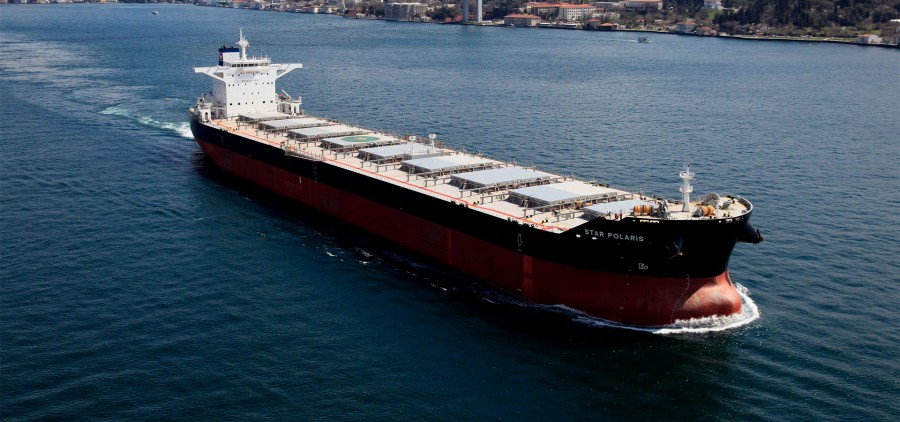
August 18, 2026 – Star Bulk Carriers Corp. (NASDAQ: SBLK) is moving forward with its fleet-renewal program while maintaining a capital-allocation approach that balances dividends, debt reduction, potential share repurchases and future vessel investments. In a recent interview with Nicolas Bornozis, President of Capital Link, Star Bulk President Hamish Norton discussed the company’s recent performance, the termination of a planned 16-vessel transaction, operational-efficiency initiatives and management’s outlook for dry-bulk demand and vessel supply.
Related materials:
- Capital Link webinar replay
- Second Quarter 2026 Earnings Release
- Second Quarter 2026 Earnings Presentation
- Second Quarter 2026 Earnings Webcast
Recent Performance and Operating Platform
Star Bulk reported its strongest quarterly results since the second quarter of 2022, supported by higher charter rates across dry-bulk vessel classes. Mr. Norton said the company was particularly pleased with the performance of its Ultramax and Kamsarmax vessels, which substantially outperformed the corresponding market indices.
The company generated a fleetwide time charter equivalent, or TCE, rate of $24,486 per vessel per day during the quarter. For the third quarter, Star Bulk had covered 62% of its available fleet days at an estimated TCE of $23,547 per day, including the expected scrubber benefit and net of commissions.
Mr. Norton attributed the results to the combination of stronger market rates, chartering performance and the company’s operating-cost structure. He also said Star Bulk earns approximately $1,500 per vessel per day more than many peers operating comparable ships, illustrating the potential effect of commercial and operating differences across large fleets.
Termination of the 16-Vessel Agreement
Recently, Star Bulk and Diana Shipping Inc. mutually agreed to terminate their agreement involving 16 vessels owned by Genco Shipping & Trading Ltd.
The agreement had been connected to Diana Shipping’s offer for Genco, which included cash and Diana shares as consideration. Mr. Norton explained that Genco management had raised concerns that the planned sale of the vessels to Star Bulk could negatively affect Diana’s share price. Because Diana shares were part of the consideration offered to Genco shareholders, terminating the vessel-sale agreement removed that issue from the proposed transaction.
Mr. Norton added that the fixed-price agreement was not intended to remain outstanding indefinitely because vessel-market conditions can change. He left open the possibility of a future agreement if Diana sought Star Bulk’s involvement, but said any new arrangement would need to reflect the circumstances prevailing at that time.
Capital Allocation and Balance Sheet
Star Bulk declared a quarterly dividend of $0.90 per share under a policy that distributes 100% of free cash flow, subject to maintaining minimum cash of $2.1 million per vessel. The payment will be the company’s 22nd consecutive dividend since 2021. Including share repurchases, Star Bulk will have returned more than $2.15 billion to shareholders over that period.
Mr. Norton said operating cash flow currently supports the dividend while the company continues to reduce debt. He noted that net debt has declined to approximately half the scrap value of the fleet.
The second-quarter presentation reported approximately $532 million in cash and cash equivalents as of August 4th and more than $640 million in pro forma liquidity, including undrawn revolving facilities. Star Bulk also had 29 debt-free vessels with an aggregate market value of nearly $790 million.
Management continues to consider several uses for vessel-sale proceeds: share repurchases, additional debt reduction, cash retention or reinvestment in the fleet. Mr. Norton said repurchases can be appropriate when the shares trade at a meaningful discount to the net liquidation value of the company’s hard assets. As that discount has narrowed, management has recently preferred to retain cash for other potential uses.
This approach separates operating cash flow, which currently supports the dividend after capital expenditures and debt service, from proceeds generated through vessel sales. Those proceeds can be allocated according to market conditions rather than automatically distributed. Mr. Norton said the company may ultimately use cash to renew the fleet when it identifies transactions expected to be accretive, while continuing to weigh those opportunities against debt reduction and repurchases.
Fleet Renewal and Acquisition Strategy
Star Bulk took delivery of three Kamsarmax newbuildings during the second quarter. Two additional vessels are scheduled for the third quarter and three for the fourth quarter of 2026. On a fully delivered basis, the company expects to own 138 vessels with aggregate capacity of approximately 13.8 million deadweight tons.
Mr. Norton said the new Kamsarmax vessels should improve the fleet’s earnings capacity because of their modern designs and lower fuel consumption. Star Bulk acquired the underlying newbuilding contracts from other parties at prices below current newbuilding levels and with earlier delivery dates than shipyards presently offer.
With newbuilding and secondhand prices elevated, Mr. Norton said purchasing vessels for cash currently appears less compelling. Share-based transactions could become more feasible if Star Bulk’s shares traded closer to net asset value or if a transaction involved another public company trading at a comparable or larger valuation discount. He cited the company’s merger with Eagle Bulk Shipping as an example of that type of structure.
Operational Efficiency and Fuel Savings
Star Bulk has fitted 88% of its fleet with energy-saving devices and continues to invest in optimized propellers, silicone-based hull coatings, telemetry and hull-cleaning technologies.
Mr. Norton said the fleet consumes roughly 650,000 metric tons of fuel annually. At an illustrative price of $600 per ton, a 10% reduction in consumption would represent approximately $39 million in annual fuel savings before other variables.
The company’s presentation reported tangible fuel savings of 7% to 15% from energy-saving devices, optimized propellers and silicone-based coatings. Star Bulk has completed 62 energy-saving-device installations, with seven more planned for 2026, and has retrofitted 125 eligible vessels with digital telemetry equipment.
Mr. Norton also discussed the cost of hull fouling, particularly after extended stays in warm-water ports, and said the company is testing hull-cleaning robots. The availability of this technology depends partly on local port regulations and whether cleaning can be performed while a vessel is moving.
He explained that individual measures can produce different levels of savings: ducts installed ahead of the propeller can reduce fuel use by about 5%, propeller optimization can save another 3% to 4%, and advanced coatings can lower resistance when properly maintained. The combined benefit varies by vessel and operating conditions, but the scale of the fleet means even incremental reductions can have a meaningful effect on annual fuel expense and emissions.
Geopolitical Developments and Trade Routes
Geopolitical disruptions can affect dry-bulk shipping through fuel prices, voyage distances and fleet efficiency. Mr. Norton said higher bunker prices can encourage vessels to sail more slowly to reduce consumption. Slower speeds reduce effective shipping capacity and can contribute to firmer charter rates, provided broader economic activity remains intact.
Star Bulk may also benefit from the price spread between very low sulfur fuel oil and high sulfur fuel oil because nearly all of its fleet is equipped with scrubbers. Mr. Norton said the spread had exceeded $150 per ton in Singapore during the period discussed.
Changes in trading relationships can also lengthen voyages. Reduced trade between Russia and Europe has caused some cargoes to travel farther, while European buyers have turned to more distant suppliers. Mr. Norton added that economic uncertainty has led some owners of smaller vessels to arrange employment closer to the commencement of a voyage, reducing scheduling efficiency across the fleet.
Dry-Bulk Demand Outlook
Star Bulk’s presentation projects dry-bulk trade growth of 2.4% in tons and 3.8% in ton-miles during 2026, followed by growth of 1.1% and 1.8%, respectively, in 2027.
Mr. Norton highlighted iron-ore exports from Brazil and Guinea, including the ramp-up of the Simandou project, as an important source of ton-mile demand. Cargoes from the Atlantic travel substantially farther to China than shipments from Australia. He also noted that China’s demand for higher-grade imported ore has remained resilient despite weakness in the country’s property sector and limited growth in steel production.
The presentation projects 2026 iron-ore trade growth of 2.8% in tons and 3.1% in ton-miles. Coal trade is projected to grow 1.0% in tons and 2.7% in ton-miles, supported by energy-security considerations and demand from India and Southeast Asia. Grain trade is projected to increase 6.5% in tons and 9.8% in ton-miles as buyers source more cargoes from the United States and Latin America amid disruption to Black Sea trade.
Mr. Norton also mentioned eventual reconstruction demand in conflict-affected regions as a possible longer-term source of cargo volumes, while acknowledging that the timing remains uncertain.
Dry-Bulk Fleet Supply Outlook
The dry-bulk orderbook has increased to approximately 13.9% of the existing fleet, while net fleet growth reached 3.3% over the 12 months covered by Star Bulk’s presentation. Mr. Norton nevertheless expressed limited concern about vessel supply because shipyard capacity remains constrained and yards generally prefer higher-value container ships, tankers and gas carriers.
A dry-bulk vessel ordered from a preferred shipyard today would likely not be delivered until 2029. Meanwhile, approximately 34.9% of the global dry-bulk fleet is more than 15 years old. The large group of vessels delivered between 2008 and 2012 will reach 20 years of age between 2028 and 2032, creating increasing replacement requirements.
Star Bulk estimates that additional special surveys and dry-docking days could reduce effective fleet capacity by more than 0.5% annually during 2026 and 2027. Mr. Norton said the combination of limited shipyard availability, high newbuilding prices and an aging fleet could result in tighter vessel supply over time.
He also noted that dry-bulk vessels are generally simpler and less profitable for shipyards to build than container ships, tankers or gas carriers. With yards already holding substantial orders for those vessel types, they have limited incentive to lower dry-bulk newbuilding prices. Although the dry-bulk orderbook has increased, deliveries are spread across more years than in earlier cycles, moderating the near-term effect on fleet growth.
In his closing remarks, Mr. Norton said market participants comparing dry-bulk companies should consider the revenues, operating expenses and overhead achieved by companies with similar fleets, as these figures can vary significantly.
About Star Bulk Carriers
Star Bulk is a global shipping company providing worldwide seaborne transportation solutions in the dry bulk sector. Star Bulk’s vessels transport major bulks, which include iron ore, minerals and grain, and minor bulks, which include bauxite, fertilizers and steel products. Star Bulk was incorporated in the Marshall Islands on December 13, 2006 and maintains executive offices in Athens, New York, Stamford and Singapore. Its common stock trades on the Nasdaq Global Select Market under the symbol “SBLK”. On a fully delivered basis and as adjusted for the delivery of the five firm Kamsarmax vessels currently under construction and the completion of the announced sale of one vessel, Star Bulk owns a fleet of 138 vessels, with an aggregate capacity of 13.8 million dwt consisting of 17 Newcastlemax, 14 Capesize, 7 Post Panamax, 42 Kamsarmax, 47 Ultramax and 11 Supramax vessels with carrying capacities between 55,569 dwt and 209,537 dwt.
In addition, in November 2021, Star Bulk took delivery of the Capesize vessel Star Shibumi, under a seven-year charter-in arrangement, and in 2024, took delivery of the vessels Star Voyager, Star Explorer, Stargazer, Star Earendel, Star Illusion and Star Thetis, each subject to a seven-year charter-in arrangement.
Capital Link – Disclaimer
Capital Link’s webinars, podcasts, articles and presentations may contain “forward-looking statements.” Statements that are predictive in nature, that depend upon or refer to future events or conditions, or that include words such as “expects,” “anticipates,” “intends,” “plans,” “believes,” “estimates,” “projects,” “forecasts,” “may,” “will,” “should” and similar expressions are forward-looking statements. These statements are not historical facts but instead represent only the beliefs of each participating Company regarding future results, many of which, in their nature, are inherently uncertain and outside of the control of the Companies. Actual results may differ, possibly materially, from those anticipated in these forward-looking statements. For more information about risks and uncertainties associated with the participating companies, please refer to the regulatory filings of each participating company with the SEC or other Stock Exchanges where they are listed.
Founded in 1995, Capital Link provides Investor & Public Relations and Media services to several listed and private companies, including companies featured in these webinars, podcasts, articles and presentations. All these, including the one mentioned above, are for informational and educational purposes and should not be relied upon. They do not constitute an offer to buy or sell securities or investment advice or advice of any kind. The views expressed are not those of Capital Link, which bears no responsibility for them. In addition, Capital Link organizes a series of industry and investment conferences annually in key industry centers in the United States, Europe, and Asia, all of which are known for combining rich educational and informational content with unique marketing and networking opportunities. Capital Link is a data partner of the Baltic Exchange. Based in New York City, Capital Link has presence in London, Athens & Oslo. For additional information please visit: www.capitallink.com.