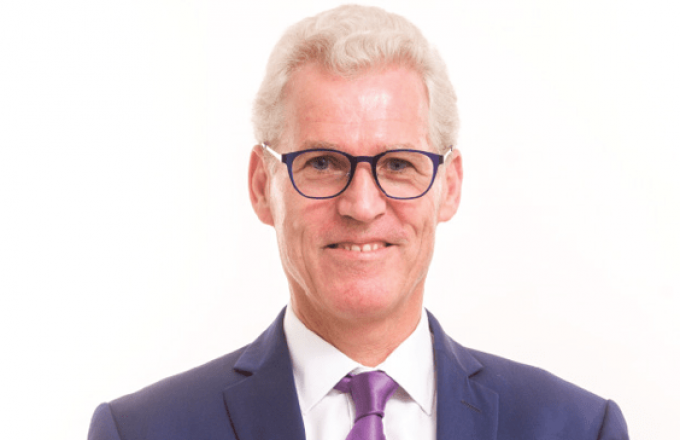
In this episode of Capital Link Riding the Waves of a Lifetime, we are joined by Jeremy Nixon , the former CEO of Ocean Network Express(ONE).
Mr. Nixon began his maritime career at sea as a navigating officer before moving into shore-based management, building more than three decades of experience in the global container shipping industry. During that time, he held senior leadership positions with P&O Nedlloyd, Maersk Line, and NYK Line, working across Europe, North America, and Asia.
In 2017, he was appointed to lead the creation of Ocean Network Express (ONE), the joint venture established by K Line, MOL, and NYK. Under his leadership, ONE commenced operations in April 2018 and has since grown into one of the world’s leading container liner shipping companies. Today, we’ll reflect on his journey, the lessons learned along the way, and his perspective on where shipping is headed next.
You can watch the full discussion here:
A decision made at sixteen
Mr. Nixon grew up on the Solent, near Southampton, close enough to the water to spend his boyhood sailing and walking the beach with his brothers, and close enough to the traffic to watch the Royal Navy working out of Portsmouth and the Merchant Navy running in and out of Southampton. By sixteen he had decided to go to sea, a choice he described as controversial and very much against his peer group.
He went to university later on, and an MBA followed, but the formative education happened aboard ship, working internationally in operational environments where people grow up quickly. The MBA brought about a decision point: stay in the maritime sector or pivot out. He doubled down, on the view that the industry was an amazing one with a great deal still to learn and a lot of professionalism in it.
Then came the move that mattered the most. At thirty he took an opportunity to leave Britain for Singapore, stepping out of the domestic safety net to explore Asia and understand its economies alongside the maritime business itself.
What a leader keeps in the toolbox
Asked to define leadership, Mr. Nixon began with the observation that everyone has been fortunate or unfortunate enough to work under many different people, and that the lessons come from watching both. A leader has to be a strategic thinker, which requires knowledge, experience and some framework for pulling the two together. A people manager, a developer of people, a motivator. Fair and upright in personal conduct, since that is what sets the culture and establishes what is acceptable in a team or a company. A clear decision maker.
“There is no single defined leadership style. I think leadership waxes and wanes, you have to have a different style for different situations and different environments.”
An experienced team that has done the work before can be delegated to, followed and checked. A young team facing a project it has never seen, or a situation turning difficult, needs the leader out in front. One does not only need the skill set, but the judgment to apply the right kind of leadership at the right moment.
Thirty-five years of consolidation and scale
Container shipping carries obligations the rest of the industry does not, Mr. Nixon shares. The carrier owns the vessel, operates it, pays the fuel bill, and deals directly with the end customer. Not one customer, either. “On any vessel, we’ll have hundreds of customers, whether shippers, consignees, notified parties.”
Half the job is moving ships safely, efficiently and on time. The other half is commercial, how hundreds of parties book and pay for cargo, and how the box moves once it leaves the quay, since container shipping has never been a port-to-port business.
He credited Malcom McLean’s standardization with everything that followed. Uniform container sizes produced uniform processes, and uniform processes made shared economies of scale possible.
Consolidation has been a big part of his working life. When he started in container shipping in the early 1990s there were somewhere close to 30 to 40 operators, some state-owned, many family-owned, all competing on price with the same ships, the same fuel oil and the same equipment, which left very little to differentiate.
By 2012 to 2014 the sector was in serious difficulty. It did not cover its cost of capital, carriers were losing money as a matter of routine, and balance sheets were in bad shape. “I think that was a huge wake-up call to the industry, that actually anybody could get into trouble, anybody could be foreclosed by their banks,” he explained. The lesson he took from it was that in a cyclical industry, a weak financial strategy and badly timed asset management can produce catastrophic corporate failure.
Scale has also affected his career in a major way. He remembered the Table Bay, a P&O Containers ship of 1985 carrying 2,800 boxes and burning 250 tons a day through twin steam turbines. Today’s 24,000 TEU vessels are six or seven times larger and sail with smaller crews than ships of the 1990s.
Scale up or get out
Mr. Nixon has been through three mergers during his career. The first was the 50-50 merger of P&O Containers and Nedlloyd, which he experienced as a young executive on the team.
The second was a takeover, Maersk acquiring P&O Nedlloyd, where he moved across with it. He described the process as fascinating, dynamic and completely unlike the first. The third was the one with no precedent, as it was done at scale involving three parties.
The story of ONE begins in 2016. We see the sector under pressure and experience Hanjin’s fresh collapse. Mr. Nixon was a corporate officer at NYK, heading the container shipping division it had moved from Tokyo to Singapore.
The question facing all three Japanese carriers was essentially “Scale up or get out.” Consolidation was running fast, survival took capital and size, and a medium-sized carrier unwilling to commit to that faced a long and painful decline toward irrelevance.
He was careful to give the shareholders their due, describing the three Nikkei-listed companies as pragmatic, able to see what was happening, and willing to extend the trust the project required.
What they agreed to was unusually radical. Three companies would become one. There would be a new brand. The company would become international, and it would not be headquartered in Japan. The ships, containers and terminals of the three parents would be leased in to a new operating company based in Singapore.
“We started with $3 billion in capital. With no assets, we just leased in,” he disclosed.
ONE went live in April 2018. Staff had been pulled from the three legacy companies six months ahead of launch, but not enough of them. According to Mr. Nixon, too many people remained with the parents. The bookings, meanwhile, did not wait as customers book four to six weeks out, so by mid-February they had stopped booking with the legacy carriers and switched to ONE. “To be very frank, we had not got the balance right. We were a little bit undercooked. We didn’t have an IT problem, which a lot of people thought we did. We just had a resource problem. We didn’t have enough staff to actually get all the reference data up and running and get everything working well,” he shared.
April through July were turbulent. By September and October, the company stabilized, the three legacy carriers were sunsetted, and ONE was running.
The next phase in need of tackling was the balance sheet. A leased fleet was never going to be the end state, so the company set about acquiring its own tonnage and containers, upgrading its IT, and buying container terminals. Winning shareholder support for that took work, and the arrival of profits made the retained earnings available to fund it.
Then came COVID, which Mr. Nixon remembers as a rollercoaster as there were three to five frightening months with no visibility on the global economy and heavy exposure to China, followed by a rebound and a rebalancing that let the company build.
He characterized all of this as the project “ONE 1.0”, his own assignment. Get the deal done, set the company up, organize it, start building the assets. A new chief executive has since been appointed from outside the company with the full support of the three shareholders, and the next chapter, “ONE 2.0”, is about scaling it up.
The servant and the slave
The standardization that built container shipping assumed one global model working in every country. The top ten carriers are each active in more than 100 markets.
Fragmentation of the world order though affects companies, boardrooms and seafarers, who now navigate a patchwork of what is permitted in one market and prohibited in the next, which ship may be used where, and which tariffs apply.
“While shipping is the servant of global trade, it cannot be the slave of global trade. It cannot be just expected to do all of this under such duress.”
He addressed politicians and economists directly, asking for more time and more respect for the industry and for its seafarers. A world that fragments into regional blocs, forfeits much of the value shipping has already created. He admitted however, that “we all individually have to hope for the best and plan for the worst.”
In practice that means stronger and more resilient risk management, contingency planning, and the leanness to redirect trading patterns quickly. Both COVID and the invasion in Ukraine demonstrated that, the latter rewiring oil, gas, energy and fertilizer flows almost entirely.
Making the case in public
On raising the industry’s profile, Mr. Nixon made it clear that individual leaders speaking up remain too fragmented to carry a message. A common voice is required, such as shipping associations which he believes have become more professional over the past five years, putting resources and time into making their case. On the container side, the World Shipping Council has strengthened, drawing in chief executives directly, building out teams in the Americas, Europe and Asia, and narrowing their messages to safety and security, stewardship of the ocean, the right of everyone to work in the industry and be treated properly, and high standards in training and recruitment.
“We, of course, as an industry, are very asset-intensive. We have a lot of steel and ships, but at the end of the day, we’re still a people’s business.”
Those still in executive seats have to lobby, in his view. Those who have stepped back, himself included, have a part to play too.
Where the remaining gains sit
Mr. Nixon thinks the ship has reached its practical limit. Ocean depths, air draft and the physical size of the cranes needed to work the vessel have taken economies of scale about as far as geography allows.
The opportunity has now moved ashore to the interface between ocean and land. Port operations have room to improve, and the system needs more capacity. “Around 10% of the container shipping industry is held up by delays on the port infrastructure or on the inland operations,” he explained.
The decarbonization balance
When asked about the ever-fervent issue of decarbonizing the sector he noted: “Clearly, there is some sort of consensus at the moment that we have to take a bit of a step back on the sustainability front. I personally think that that is misguided.”
Looking at the environmental damage underway and at global warming, he finds it very difficult to believe this is 100% natural and takes the view that the human race has to accept more responsibility for it. He conceded that yes, fuel types and technology have not fully matured, and loading undue costs onto global supply chains carries adverse effects of their own. What he asked for was balance. “It can’t be all green, but it can’t be all just staying with the way we’re going.’
A ship takes three to four years to plan, order and deploy, and a vessel leaving the yard two or three years from now will still be trading after 2050. The industry has to find a decarbonization paradigm that works for the planet, works as a business, and holds up scientifically.
On legacy
On what he hopes his contribution will be, Mr. Nixon started with gratitude. Thirty-five years, general cargo and containers, in a sector with special people, serving global trade and making transportation safer, can only make one feel grateful. But when it came to practical advice, he insisted on appetite as a driving force.
“We’ve had shipping as an industry for thousands of years, so you could never say that we’ve got this industry completely locked down and nailed. I think we still have more to do.”
His own mantra is to learn something new every day, “look at what you do, ask how it could be done better, safer, quicker, more effectively. Learn from the people around you. Be humble. Work with people, help people. And, if you do that, they’ll help you, and if they help you, they’ll make your company better. And if they make your company better, they’ll make your industry better. If they make your industry better, they’ll make the world better,” he concluded.
Capital Link’s Riding the Waves of a Lifetime Series
Tune in Every Tuesday and Thursday.
Exclusive Season Sponsor: White & Case
For more information follow here:
Capital Link – Disclaimer
Capital Link’s webinars, podcasts, articles and presentations may contain “forward-looking statements.” Statements that are predictive in nature, that depend upon or refer to future events or conditions, or that include words such as “expects,” “anticipates,” “intends,” “plans,” “believes,” “estimates,” “projects,” “forecasts,” “may,” “will,” “should” and similar expressions are forward-looking statements. These statements are not historical facts but instead represent only the beliefs of each participating Company regarding future results, many of which, in their nature, are inherently uncertain and outside of the control of the Companies. Actual results may differ, possibly materially, from those anticipated in these forward-looking statements. For more information about risks and uncertainties associated with the participating companies, please refer to the regulatory filings of each participating Company with the SEC or other Stock Exchanges where they are listed.
Founded in 1995, Capital Link provides Investor & Public Relations and Media services to several listed and private companies, including companies featured in these webinars, podcasts, articles and presentations. All these, including the one mentioned above, are for informational and educational purposes and should not be relied upon. They do not constitute an offer to buy or sell securities or investment advice or advice of any kind. The views expressed are not those of Capital Link, which bears no responsibility for them. In addition, Capital Link organizes a series of industry and investment conferences annually in key industry centers in the United States, Europe, and Asia, all of which are known for combining rich educational and informational content with unique marketing and networking opportunities. Capital Link is a data partner of the Baltic Exchange. Based in New York City, Capital Link has presence in London, Athens & Oslo. For additional information please visit: www.capitallink.com.