“Dark fleet vessels are ticking time bombs” – Japanese shipowners and financial institutions urged to support safe ship recycling
October 18, 2026 | Maritime Bridge Japan
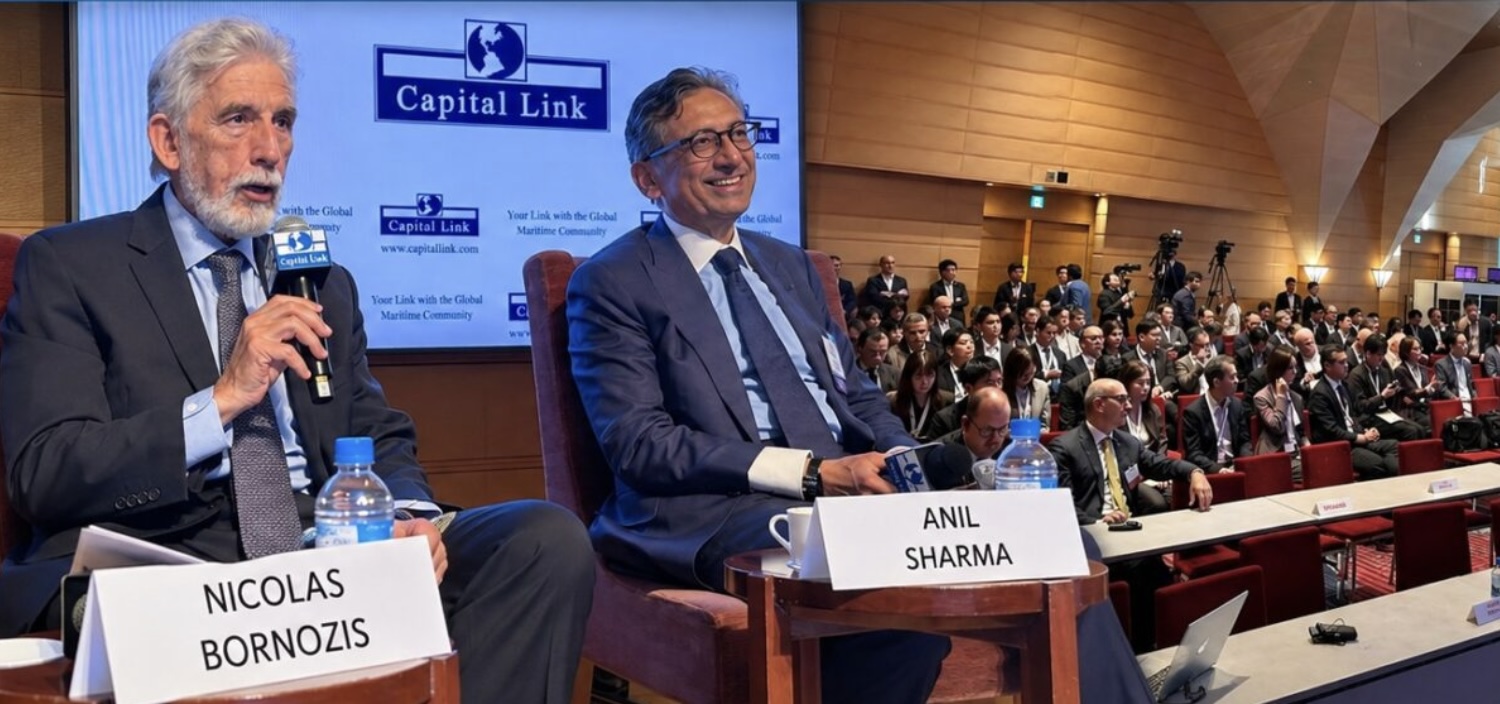
Anil Sharma, founder and chief executive officer (CEO) of GMS, a leading global ship recycling company, discussed the risks posed to the shipping industry by the recycling of sanctioned vessels and the expansion of the “dark fleet” at the 5th Annual Capital Link Japan Maritime Forum, held at the Tokyo American Club on 16 October.
He expressed concern that ageing vessels are being kept out of the conventional ship recycling market and continue operating without adequate safety oversight.
Ageing vessels accumulate as recycling market faces risk of a “dam bursting”
The discussion, entitled “NAVIGATING A NEW MARITIME REALITY – SANCTIONS & THE DARK FLEET”, was moderated by Nicolas Bornozis, president of Capital Link, Inc.
Citing estimates from the international shipping association BIMCO, Bornozis said more than 16,000 vessels could become candidates for recycling over the next decade. He asked how the easing of sanctions and technological advances might affect demand for ship recycling in the coming years.
Sharma compared the accumulation of ageing vessels that have not been recycled to water being held back by a dam.
“The question is whether this water will be released gradually or whether the dam will burst. What I fear is the dam bursting.”
According to Sharma, GMS had handled ship recycling transactions involving approximately 150 to 200 vessels a year over many years, but the number had fallen to around 60 to 70 vessels annually over the past five years.
He said one factor was that ageing vessels were being used to transport sanctioned cargoes rather than returning to the recycling market.
“Sanctions have not stopped ships; they have removed the rules”
Sharma argued that sanctions policies had inadvertently created new problems for maritime safety and environmental protection.
“Sanctions have not eliminated the business. They have not stopped ships from operating. We have taken away the rules.”
He explained that vessels previously subject to appropriate classification society inspections and covered by insurance were moving into sanctioned trades, where they continued operating without adequate oversight.
“Ships carrying one million or two million barrels of oil are sailing the seas like ticking time bombs.”
Sharma expressed concern that accidents involving such vessels could have serious consequences for the marine environment. He called for mechanisms to ensure that ageing vessels could be safely withdrawn from service, separately from the objectives of sanctions.
On the size of the dark fleet, Bornozis referred to external data putting it at approximately 16 per cent of the global fleet. Sharma suggested that the figure could reach around 20 per cent, depending on changes in the scope of vessels covered.
These figures, however, were estimates presented during the discussion rather than definitive statistics.
US authorisation enables GMS to handle six sanctioned vessel recycling cases
GMS has been working to obtain authorisation from the US Treasury’s Office of Foreign Assets Control (OFAC) to recycle sanctioned vessels legally.
According to Sharma, obtaining the initial authorisation took approximately seven months. The company subsequently proceeded with two additional vessels, bringing the total to six vessels involved in recycling cases requiring OFAC authorisation.
The procedures for the two additional vessels progressed within a matter of weeks, he said.
Sharma explained an approach under which negotiations for a vessel sale and purchase agreement are conducted subject to obtaining an OFAC licence, followed by a formal application for authorisation.
He emphasised that the identity of the counterparty and the ultimate recipient of the sale proceeds were important considerations.
Sharma cited a hypothetical transaction involving a Japanese ship leasing company. He explained that even if a shipowner leasing a vessel from a Japanese leasing company became subject to US sanctions, an OFAC licence might be obtained relatively quickly if the sale proceeds were paid to the non-sanctioned Japanese leasing company rather than to the sanctioned shipowner.
Whether authorisation is granted, and how long the review takes, depends on the circumstances of each individual case.
Sharma also addressed the possibility that the US might allow some sanctioned vessels to return to the conventional shipping market. He expressed reservations about whether ageing vessels, including those more than 20 years old and facing problems relating to classification or flag registration, could readily return to service.
Even where vessels were able to return, their use might be limited to particular trades, such as short-haul voyages within the Persian Gulf, he said.
Japanese shipowners urged to approve more recycling yards
Sharma praised the role played by the Japanese government and ClassNK in the Hong Kong International Convention for the Safe and Environmentally Sound Recycling of Ships (Hong Kong Convention), which entered into force in June 2025.
He said Japan had played an extremely important role in establishing a framework for sustainable and responsible ship recycling.
He pointed out, however, that the processing capacity of recycling yards meeting international standards would become a challenge if demand for recycling ageing vessels increased sharply.
According to Sharma, the global ship recycling market has previously handled approximately 60mn to 62mn deadweight tonnes a year. He suggested that capacity could reach around 75mn deadweight tonnes annually if appropriate facilities and approval arrangements were in place.
He called on Japanese shipowners to increase the number of approved recycling yards.
“I am not asking Japanese shipowners to lower their quality standards. I am asking them to encourage more yards to improve so that they can meet those standards.”
He explained that shipowners could help expand safe ship recycling capacity by supporting improvements at recycling yards while maintaining stringent standards.
Wide variations in scrap prices affect residual value assessments
Sharma also addressed price fluctuations in the ship recycling market.
According to Sharma, a recent LNG carrier recycling transaction encountered problems with documentation at the recycling yard, making it necessary to change the originally intended recycling yard. This resulted in a difference of approximately $50 per tonne in the sale price.
He explained that even a price difference of this magnitude could amount to approximately $1mn for an entire vessel.
Sharma recalled that when he began working in ship recycling, prices were around $100–$150 per tonne, but had subsequently reached as much as $800 per tonne at certain times.
He said current prices averaged around $450 per tonne, occasionally reaching approximately $500. However, he expressed reservations about using such prices as a fixed benchmark for assessing the future residual value of vessels.
Some financial institutions use approximately $350 per tonne as a benchmark for residual value assessments, a level Sharma regarded as relatively realistic.
Fluctuations in recycling prices affect not only shipowners’ decisions to sell vessels but also the asset valuations of financial institutions holding ships as collateral.
A new role for Japan’s shipping industry
Sharma also described the expansion of the fleet owned by Lila Global, the shipowning business, while GMS’s ship recycling operations had slowed.
The company has pursued vessel investments based on the value of ships as steel, building a fleet of nearly 50 vessels, including containerships, bulk carriers, LNG carriers and stainless steel chemical tankers.
He explained that the company acquires relatively ageing vessels and upgrades their equipment during dry-docking, keeping them in a condition that allows them to operate for several more years.
Towards the end of the discussion, the speakers also addressed changes in Japan’s crude oil transportation and supply chains surrounding the Strait of Hormuz.
Sharma said oil producers were increasingly quoting sales prices on CIF terms, while commodity traders were securing shipping capacity in advance, reflecting changes in trading terms and commercial flows.
He also referred to Japanese-linked vessels conducting ship-to-ship (STS) cargo transfers in locations including Malaysia and Oman.
The safe withdrawal of sanctioned vessels from service, expansion of ship recycling capacity and stable energy transportation have become issues of relevance to Japanese shipowners and financial institutions.
Reporter’s View: Japan’s maritime industry has a role in the safe withdrawal of dark fleet vessels
The discussion highlighted the importance of establishing mechanisms for the safe recycling of sanctioned vessels. If ageing ships continue operating outside established classification and insurance frameworks, the risks of maritime accidents and oil pollution could increase, with consequences potentially extending to vessels and coastal states unconnected with the sanctions.
Japan has a broad industrial base encompassing shipbuilding, shipowning, finance, classification and recycling. It is well placed to make an international contribution both to developing safe recycling capacity in accordance with the Hong Kong Convention and to establishing mechanisms for withdrawing ageing vessels from service while complying with sanctions regulations.
The involvement of Japanese shipowners and financial institutions in developing suitable recycling yards and expanding their approval could help reduce environmental impacts and improve maritime safety. Addressing the challenges arising at the intersection of sanctions and shipping realities could become a new international role for Japan’s maritime industry.
Maritime Bridge Japan Editorial Team