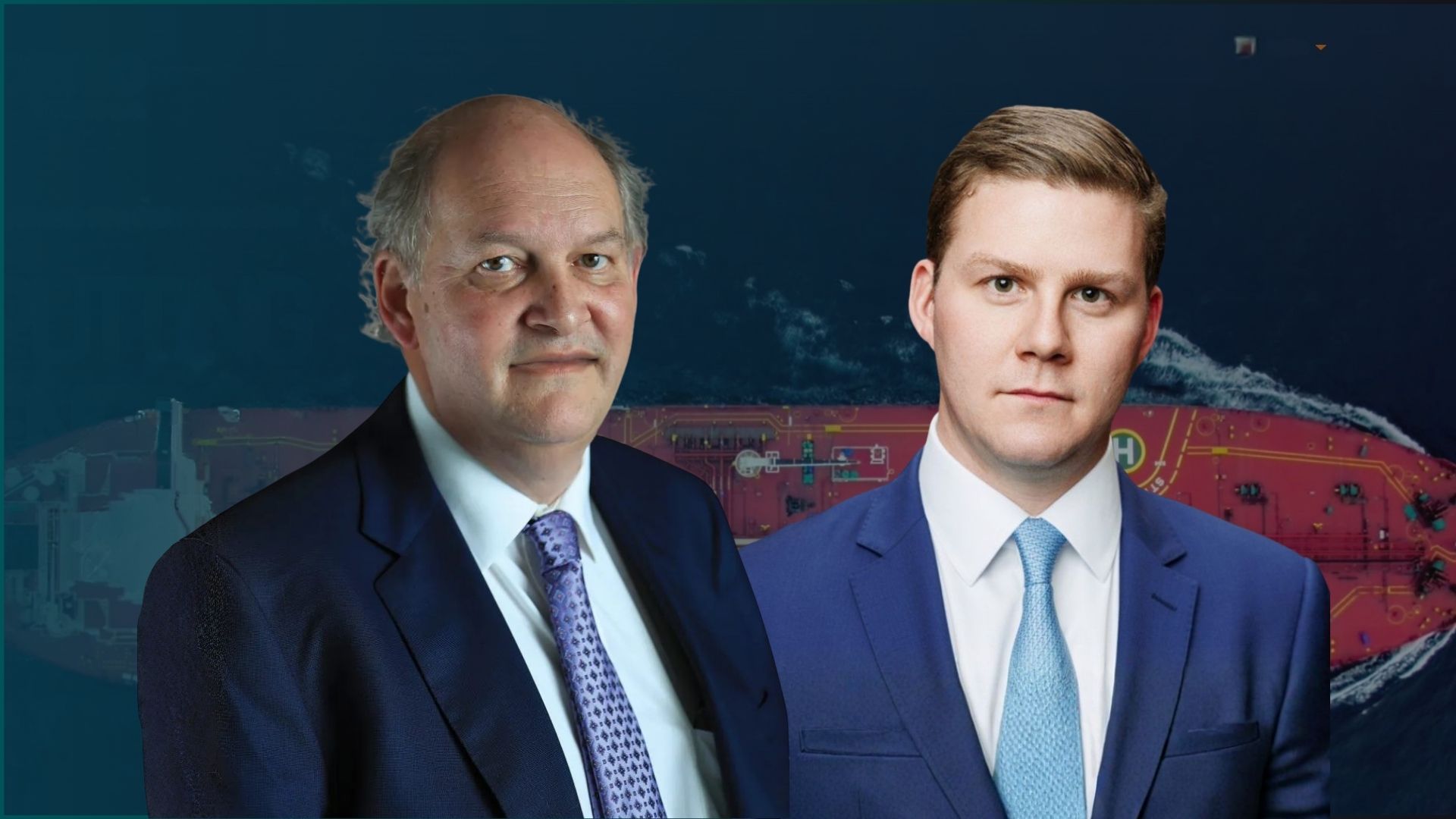
In this episode of Capital Link’s Trending News Podcast, Mr. Robert Bugbee , President & Director of Scorpio Tankers Inc. (NYSE: STNG) and Mr. James Doyle, CFA , Head of Corporate Development & IR discussed how the potential reopening of the Strait of Hormuz is about to affect an already strengthening market.
Evidently, the closure of the Strait has dominated shipping headlines in the past few months, but Mr. Doyle believes the strongest case for product tankers extends well beyond the latest geopolitical crisis. In fact, he argues that a combination of refinery closures, shifting trade routes and the aging fleet are creating structural support for product tanker demand that could persist for years, even if Middle East tensions ease.
After all, before disruptions intensified, MR earnings were reaching $30,000 per day and LR2 returns near $40,000.
To watch the full discussion, please visit the following link:
A Mismatch of Refining Capacity & Consumption Centers
For STNG, the bigger story is not what happens in the Gulf over the next few months, but how the refining system has changed over the last decade worldwide. Refinery closures in Europe, Japan, Australia and parts of the United States have become more dependent on long-haul product movements from large export hubs in the Middle East, India and Asia.
At the same time, “there is steady demand in those regions. It has not declined as much as reports five years ago, two years ago predicted,” Mr. Doyle noted, indicating that the market is now dictated by ton-miles, not outright fuel consumption growth.
He sees emerging markets as an essential source of future cargo demand. He further supported that countries with limited domestic refining capacity will continue relying on imports of gasoline, diesel and jet fuel. According to Mr. Doyle, refinery construction timelines remain lengthy, limiting the prospect of new capacity entering the market in the near future.
Taking into account, the aging fleet profile, 30% of which will be more than 20 years old by 2028, Mr. Doyle sees a natural source of fleet attrition.
Trade Patterns Continue to Evolve
Mr. Doyle also suggested some trade pattern changes created during the disruptions may prove permanent. He actually pointed to shipping traffic through the Red Sea as an example.
While yes, attacks near Bab el-Mandeb forced vessels onto longer routes around the Cape of Good Hope, cargo volumes did not return after security conditions improved.
“When they stopped attacking ships, volumes never recovered. They’re still 30-40% of the levels they were before,” he divulged.
Mr. Doyle heavily focused on the impact of inventory depletion. He alluded to the fact that the market may be underestimating the scale of future replenishment demand. Rebuilding inventories could become a process that takes years.
Mr. Bugbee agreed that inventory rebuilding could support tanker demand but cautioned against assuming it would automatically trigger exceptionally high freight rates.
“It may stop a collapse in the market to $10-15,000 a day, for example, or operating break-evens, but it may not take whole VLCC markets in the hundreds.”
That experience could show that governments and energy companies will potentially prioritize supply security over efficiency. New pipeline projects in the UAE, expanded use of Saudi infrastructure and growing exports from Atlantic Basin producers like Brazil, Guyana and Canada could all contribute to longer average voyage distances.
Inventory Depletion and Restocking: Supportive but Not Linear
A key near-term variable is the global inventory cycle. Scorpio noted that prolonged disruption has significantly drawn down global product inventories, potentially setting up a multi-year restocking phase.
For product tankers, restocking process is constrained, as refinery capacity is mostly fixed in the short term and there is very little that can be done to quickly expand output. As a result, rebuilding inventories of gasoline, diesel, and jet fuel is inherently gradual and tied to existing refining throughput.
For crude tankers, restocking is more layered, combining inventory rebuilding with rising supply from growth regions such as Guyana, Brazil, West Africa, Venezuela and the U.S., which can flow into the system more flexibly.
However, management cautioned against assuming a straightforward demand surge.
While inventory rebuilding could support tanker utilization over time, Mr. Bugbee emphasized that the impact may be more stabilizing than explosive, helping prevent a sharp downturn in rates rather than guaranteeing sustained super-cycles.
Balance Sheet Transformation
Scorpio Tankers’ financial position has seen some major shifts over the past several years. The company has spent these years aggressively deleveraging and renewing its fleet. Its net debt stood at $2.9 billion at the end of 2021. By May 2026, it had moved into a net cash position, with gross debt of $932 million and cash exceeding $1 billion.
Mr. Bugbee, noted that the balance sheet has strengthened even further since the company’s latest reported figures, helped by vessel sales and strong spot-market earnings. He added that the stronger balance sheet is reducing financing costs as well as debt repayment obligations.
“What this strength of balance sheets is allowing us to do is to rapidly lower our interest costs, lower our principal repayments.” For Mr. Bugbee, that flexibility matters more than maximizing short-term shareholder distributions. Scorpio plans to maintain a regular dividend policy and preserve financial firepower for future opportunities.
According to him, lower debt service requirements continue to push down cash breakeven levels across the fleet. That creates a profitable position to be in during a period of uncertainty, he reiterated.
Fleet Renewal Continues
The company has also continued selling older vessels at historically attractive prices and adding modern tonnage. Scorpio currently has ten newbuildings scheduled for delivery through 2029 and Mr. Bugbee sees opportunities to expand the company’s presence in the VLCC sector.
Even in that area, however, Mr. Bugbee sees reasons for caution. The VLCC orderbook now exceeds 30% of the existing fleet, a level he believes could eventually pressure vessel values.
“I think that people who are expecting a big positive event in the VLCCs over the next few years may be sadly surprised,” he commented.
For now, the company appears content to let cash accumulate and maintain its exposure to the spot market.
When asked about the “dark fleet,” Mr. Bugbee noted that its relevance is likely to diminish over time as effective supply is measured against modern, efficient tonnage rather than headline fleet counts. He added that retirement or scrapping decisions remain fundamentally rate-driven, meaning prevailing earnings will ultimately determine whether older vessels continue trading or exit the market.
Capital Link Editorial
About Scorpio Tankers Inc.
Scorpio Tankers Inc. is a provider of marine transportation of petroleum products worldwide. Scorpio Tankers Inc. currently owns 83 product tankers (32 LR2 tankers, 37 MR tankers and 14 Handymax tankers) with an average age of 10.2 years. The Company has reached agreements to sell two MR product tankers and seven LR2 product tankers, which are expected to close in the second or third quarter of 2026. The Company has also reached agreements or letters of intent for six MR newbuildings (including the two mentioned in this press release) that are currently under construction with deliveries expected in 2026, 2027 and 2030, four LR2 newbuildings with deliveries expected in 2027 and 2029 and two VLCC newbuildings with deliveries expected in 2028. Additional information about the Company is available at the Company’s website www.scorpiotankers.com, which is not a part of this press release.
Capital Link – Disclaimer
Capital Link’s webinars, podcasts, articles and presentations may contain “forward-looking statements.” Statements that are predictive in nature, that depend upon or refer to future events or conditions, or that include words such as “expects,” “anticipates,” “intends,” “plans,” “believes,” “estimates,” “projects,” “forecasts,” “may,” “will,” “should” and similar expressions are forward-looking statements. These statements are not historical facts but instead represent only the beliefs of each participating Company regarding future results, many of which, in their nature, are inherently uncertain and outside of the control of the Companies. Actual results may differ, possibly materially, from those anticipated in these forward-looking statements. For more information about risks and uncertainties associated with the participating companies, please refer to the regulatory filings of each participating company with the SEC or other Stock Exchanges where they are listed.
Founded in 1995, Capital Link provides Investor & Public Relations and Media services to several listed and private companies, including companies featured in these webinars, podcasts, articles and presentations. All these, including the one mentioned above, are for informational and educational purposes and should not be relied upon. They do not constitute an offer to buy or sell securities or investment advice or advice of any kind. The views expressed are not those of Capital Link, which bears no responsibility for them. In addition, Capital Link organizes a series of industry and investment conferences annually in key industry centers in the United States, Europe, and Asia, all of which are known for combining rich educational and informational content with unique marketing and networking opportunities. Capital Link is a data partner of the Baltic Exchange. Based in New York City, Capital Link has presence in London, Athens & Oslo. For additional information please visit: www.capitallink.com.