Five shipowners discuss their Japan strategies at the 5th Annual Capital Link Japan Maritime Forum
October 16, 2026 | Maritime Bridge Japan
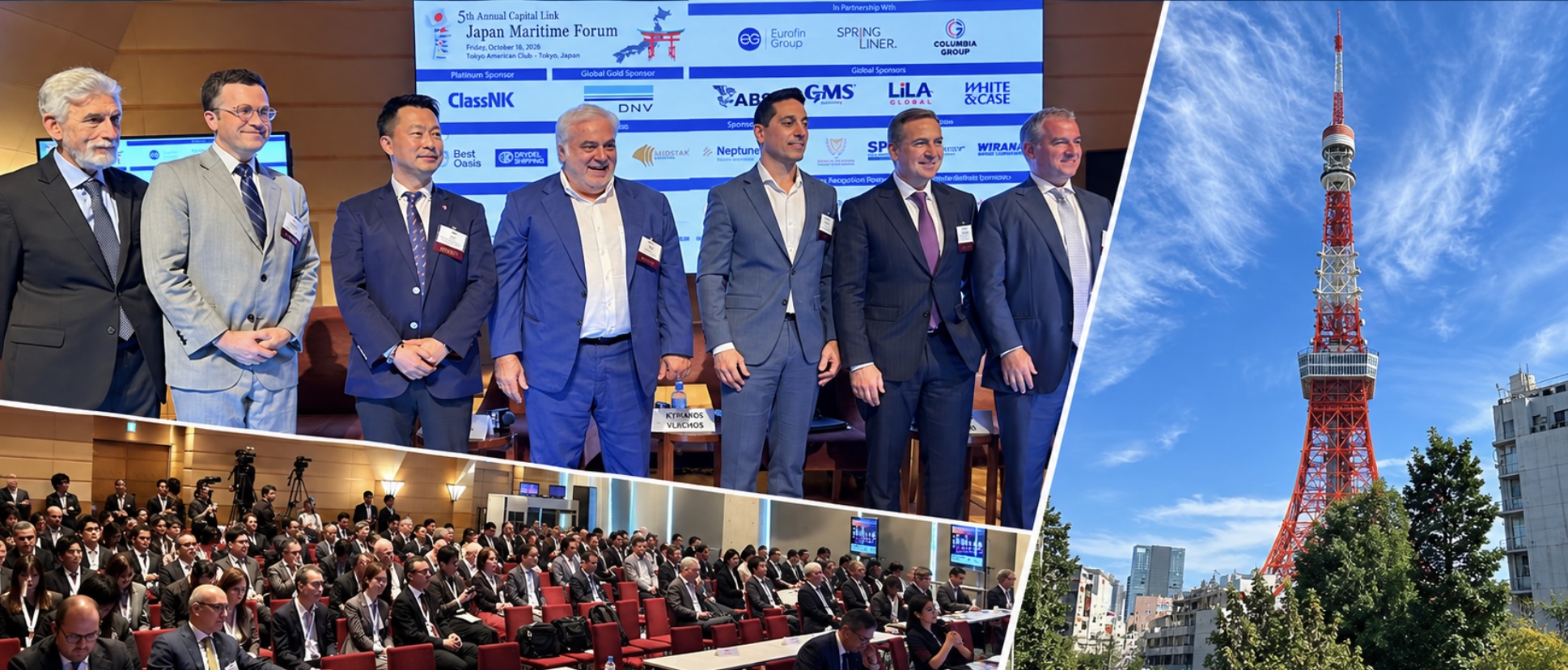
Senior executives from five international shipowning companies, mainly based in Europe, took part in the 5th Annual Capital Link Japan Maritime Forum, held at the Tokyo American Club on 16 October, discussing their business relationships with Japan, shipbuilding, ship finance and decarbonisation.
The companies praised the creditworthiness of Japanese businesses and their long-standing partnerships, while expressing concern over the rise of China’s shipbuilding industry. They also exchanged views on financing arrangements, including Japanese Operating Leases with Call Options (JOLCOs), and approaches to next-generation marine fuels.
Japan seen as a key market, with trust and track record highly valued
The 5th Annual Capital Link Japan Maritime Forum brought together senior executives from shipowning companies, financial institutions, shipyards and trading houses in Japan and around the world to discuss shipping markets, investment, ship finance, decarbonisation and geopolitical risks.
The session, “GLOBAL SHIPOWNERS DOING BUSINESS IN JAPAN”, was moderated by Nels Hansen, a partner in the Tokyo office of US law firm White & Case LLP. Senior executives from five international shipowning companies discussed Japan’s position in their business strategies.
John Su, Founder, President and CEO of Erasmus Shipinvest Group, emphasised: “Japan is the most important market for us across every aspect of our commercial activities.”
The group maintains offices in Tokyo and Imabari and conducts business with Japanese companies across a wide range of activities, including newbuilding orders, secondhand vessel sales and purchases, ship finance and chartering.
Su said: “In Japan, a company’s creditworthiness, track record and ability to execute business are respected. This is a characteristic that clearly distinguishes Japan from other countries.”
Turning to Japanese shipbuilding, he said: “We hope to see earlier building slots, greater shipbuilding capacity and more competitive prices,” calling for an expansion of production capacity.
“If you can do business in Japan, you can be trusted anywhere in the world”
Marco Fiori, CEO of Italian shipowner Premuda SpA, stressed that personal relationships were the most important aspect of doing business with Japan.
“In Japan, business cannot be conducted solely through emails or Teams. You need to visit in person, sit down face to face, share meals and talk about life as well as business.”
Fiori said he had already visited Japan four or five times this year. “I do not regard our Japanese contacts simply as counterparties. They are our Japanese partners,” he said.
He added: “If you can do business in Japan, you can be a trusted partner anywhere in the world.”
He suggested that a record of doing business with Japanese companies served as evidence of credibility in the international shipping market.
Kyriakos Vlachos, Group Co-CEO and CFO of Schoeller Holdings, also highlighted Japan’s distinctive business practices.
“In many markets, a deal is concluded first and the details are worked out afterwards. In Japan, however, a great deal of preparatory work is required before an agreement is reached. Once a commitment has been secured, its execution proceeds remarkably smoothly.”
Vlachos praised the careful decision-making of Japanese companies and their strong ability to honour commitments once agreements had been reached.
Twenty of 24 newbuilding orders placed with Japanese shipyards
Polys Hajioannou, CEO of Safe Bulkers, Inc., outlined his 40-year relationship with the Japanese market.
According to Hajioannou, 20 of the 24 newbuildings ordered between 2020 and 2025 were placed with Japanese shipyards. Before 2010, the company placed 100% of its newbuilding orders in Japan.
“It is a real pleasure to do business in Japan. Once an agreement is reached, the commitment is honoured, regardless of when the contract is signed.”
Hajioannou also recalled how, during the difficult shipping market conditions of 2011, the company secured financing on favourable terms for four newbuildings through a Japanese government export credit scheme.
He expressed serious concern, however, about the rapid expansion of China’s shipbuilding industry.
“Our biggest concern is how Japanese shipyards will respond to the intense competition from China.”
Against the backdrop of China’s expanding shipbuilding capacity, Hajioannou welcomed Japanese government support for the domestic shipbuilding industry.
“Japanese shipyards use high-quality steel to build vessels that remain in good condition even at 20 years of age,” he said, highlighting what he regarded as the superior quality of Japanese-built ships.
Japan regains prominence as London and New York lose ground
Stamatis Tsantanis, Chairman and CEO of Nasdaq-listed Seanergy Maritime Holdings Corp., said Japan was gaining prominence in the global shipping industry.
“London and New York, once the centres of the global shipping industry, are losing their prominence. Japan, meanwhile, has significantly regained its position over the past few years, not only in shipbuilding but also in ship finance and commercial activities.”
Tsantanis said he expected the combined value of the company’s transactions in Japan over the past five years and those anticipated over the next five years to exceed $1bn. These transactions include secondhand vessel purchases, newbuilding orders, ship finance and chartering.
He also described changes in the nature of transactions with Japanese companies.
Alongside traditional long-term charter contracts, there has been a growing preference for relatively short-term transactions with Greek shipowners with whom Japanese companies have established relationships of trust.
“What matters is not just the vessels we have acquired or the value of the transactions. It is the partnerships and friendships we have built with our Japanese counterparts.”
Vlachos also discussed co-operation with MOL on an offshore wind-related project. According to Vlachos, the partners contributed their respective strengths, including vessel design, newbuilding supervision, ship management and offshore expertise.
“By combining different capabilities, rather than simply bringing in Japanese capital, projects can be realised more quickly and with lower risk,” he said.
Shipowners divided over next-generation fuels, with some favouring conventional options
The shipowners expressed differing views on decarbonisation and next-generation marine fuels.
Vlachos said: “LNG and methanol are currently commercially viable fuels,” citing the availability of vessels, engines and fuel supply infrastructure.
He suggested that ammonia could become an important option in the medium to long term, supported by Japanese government initiatives and the development of supply chains.
Tsantanis, however, questioned the environmental performance, economics and safety of alternative fuels.
“We intend to continue using conventional fuels for the foreseeable future. There is the question of who will bear the additional costs, as well as concerns about the safety of fuels such as ammonia.”
Fiori argued that substantial reductions in fuel consumption could be achieved through fleet renewal alone, by replacing existing vessels with more energy-efficient eco-ships. He said shipowners had a responsibility to continue renewing their fleets.
Hajioannou, by contrast, emphasised the possibility that the drive towards decarbonisation could accelerate again.
“We must not lose sight of decarbonisation. Change could come sooner than we think.”
He stressed the importance of preparing for tighter regulations in the future, even if there was no immediate need to rush investment decisions on next-generation fuels.
Shipowners differ over JOLCO use, emphasise diversification of funding sources
Differences in the companies’ strategies also emerged over the use of Japanese Operating Leases with Call Options (JOLCOs).
Su acknowledged that JOLCOs offered competitive financing terms, but stressed the importance of flexibility in vessel sales and financing to respond to fluctuations in shipping markets.
Fiori also described his previous experience with JOLCOs, suggesting that direct transactions with Japanese shipowners and financial institutions offered greater flexibility, including in the exercise of options.
Tsantanis, meanwhile, revealed that discussions were under way with a view to concluding a new JOLCO transaction in the near future.
Hajioannou expressed strong support for JOLCOs and sale-and-leaseback transactions with Japanese shipowners.
“Companies need to have a broad funding base. Even if you do not need financing today, you never know what may happen tomorrow.”
According to Hajioannou, Safe Bulkers has completed approximately 15 JOLCO and sale-and-leaseback transactions in Japan over the past decade. Such financing arrangements in the Japanese market account for around 40% of the company’s funding, he said.
“JOLCO is a very good financial product,” he said, emphasising that it also helped build long-term relationships with Japanese investors and shipowners.
The discussion highlighted a shared recognition that the strengths of the Japanese market extended beyond its financial resources and shipbuilding technology to encompass creditworthiness, the ability to honour contractual commitments and long-standing personal relationships.
At the same time, it brought renewed attention to the challenges facing Japan’s maritime industry, including competition from Chinese shipbuilders, the transition to next-generation fuels and the diversification of financing arrangements.
Reporter’s View
Japan’s maritime industry can turn trust with international shipowners into a driver of growth
One of the most striking aspects of the discussion was the repeated emphasis by international shipowning executives on their long-standing relationships of trust with Japanese companies.
Their business activities span shipbuilding, ship finance and chartering, but a common theme was their appreciation of Japanese counterparties for honouring commitments and maintaining stable business relationships.
Japan’s shipbuilding industry faces challenges in expanding construction capacity and improving price competitiveness. Government initiatives to support the industry could provide an opportunity to capture further demand from overseas shipowners for Japanese-built vessels.
In ship finance, increased funding is also expected through JOLCOs and sale-and-leaseback arrangements.
By further strengthening their relationships with international shipowners, Japanese shipyards, shipowners and financial institutions have the potential to open up new business opportunities.
Maritime Bridge Japan Editorial Team